
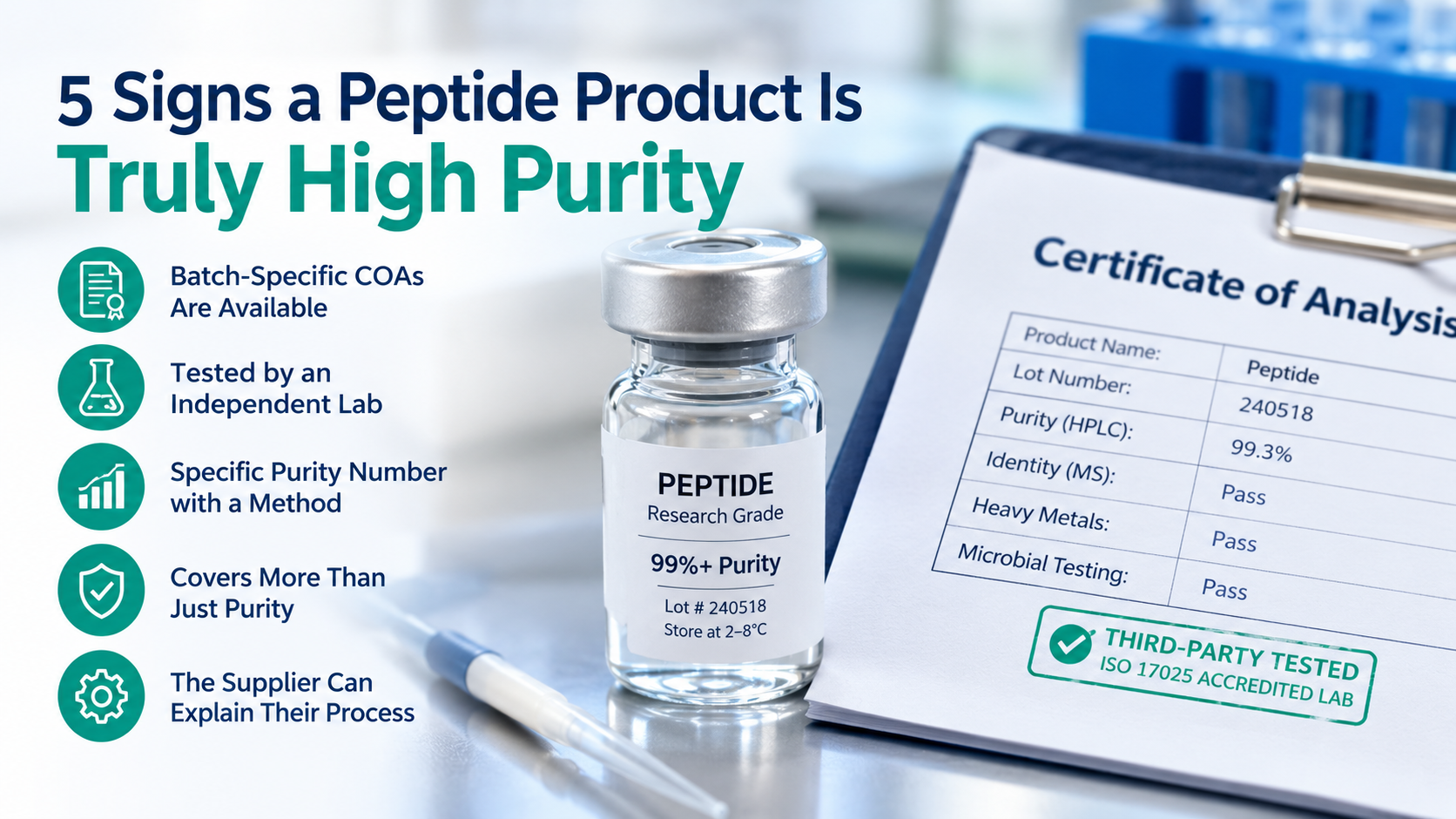
‘High purity’ appears on roughly 95% of peptide product listings. It costs nothing to claim. There is no verification requirement. The words prove absolutely nothing about what’s inside the vial. Products that genuinely are high purity have documentation proving it. Products that aren’t high purity also say they are. Telling the difference requires knowing what real evidence actually looks like.
Here are five signs the purity claim is real rather than decorative.
This article belongs to Health
Table of Contents
1. Batch-Specific Certificates of Analysis Are Available
Not a certificate from eight months ago on a completely different production run. A document tied to the specific lot number currently being shipped, produced after that specific batch was actually tested. The lot number should appear on the product label and on the certificate, and they need to match.
Suppliers with real quality standards publish this without being asked. Some put it directly on the product page. Others send it on request within a business day. Suppliers who can’t produce a lot-specific certificate are offering documentation that verifies nothing in particular.
2. The Testing Was Done by an Independent Lab
Internal testing is a company grading its own homework. The conflict of interest is obvious. Third-party testing from an accredited lab with no financial relationship to the supplier is a completely different category of document. The lab name should be identifiable and accredited for the methods used.
If the certificate looks official but searching for the testing laboratory turns up nothing, that’s a meaningful red flag. Accredited labs exist in the world and are findable. A lab that can’t be found with a basic search is its own answer.
3. Purity Is Reported as a Specific Number with a Method
‘High purity’ is a marketing phrase. ‘98.2% by HPLC’ is evidence. For purity peptides, the expectation is a specific number derived from a specific analytical method. HPLC is the standard approach. The method should be clearly stated on the certificate. Suppliers with real data share it because they have it.
Suppliers who rely on vague language don’t provide specifics because specific language requires documentation they either don’t have or have no interest in sharing.
4. The Certificate Covers More Than Just Purity
Purity testing tells you what percentage of the content is actually the stated compound. Identity confirmation tells you whether it’s genuinely that compound or something that just looks similar on a label. Heavy metal screening tells you whether the production process left anything behind that shouldn’t be there.
Microbial contamination testing tells you whether the product is safe in the most basic biological sense, which is a bar that should be easy to clear and somehow isn’t always. Four different questions. Four different tests. A certificate that only answers one of them is not comprehensive documentation, whatever it says at the top.
5. The Supplier Can Explain Their Process
A quality supplier can answer basic questions about synthesis, raw material sourcing, and quality control without the conversation suddenly becoming about their founding story and commitment to excellence. Simple questions. Where does synthesis happen, in-house or through a contract manufacturer? What standards does that manufacturer actually operate under? How often does testing happen, and what does it cover? None of that is invasive.
Conclusion
Everything on this list comes down to the same thing. Verifiable information instead of claims. Documented evidence instead of confidence. Transparency is easy for suppliers who have nothing to hide.
For the ones who do, it becomes surprisingly difficult to schedule, repeatedly unavailable, or answered with something that sounds like an answer but technically isn’t. That pattern is itself the answer. The inconvenience is the information.
